

SAT scores are highly dependent on your family’s income.
Imagine there is a boy named Oliver whose dream is to attend Massachusetts Institute of Technology (MIT), a very prestigious university. To get into MIT, Oliver must take the Scholastic Assessment Test (SAT), a test many colleges use to determine if a student is a good fit for their institution. To prepare for the SAT exam, Oliver spends $1,000 on an SAT prep course. He also takes the test three times to ensure he gets the score he wants, which will cost him an additional $200. Time passes, and Oliver’s tests are graded. He receives excellent marks! He submits his application to MIT and gets accepted!
Suppose, however, that there is another person named Ava who also aspires to go to MIT. Her financial situation prevents her from taking the SAT two or three times, so she takes the SAT only once. Moreover, she cannot afford any SAT prep courses to help her prepare for the test. Unfortunately, her SAT score isn’t great, and she doesn’t get into MIT.
While it sounds drastic, this story is more realistic than you might expect. SAT scores are surprisingly dependent on your wealth since SAT prep is practically a necessity if you want to get a good score and can cost a hefty price.
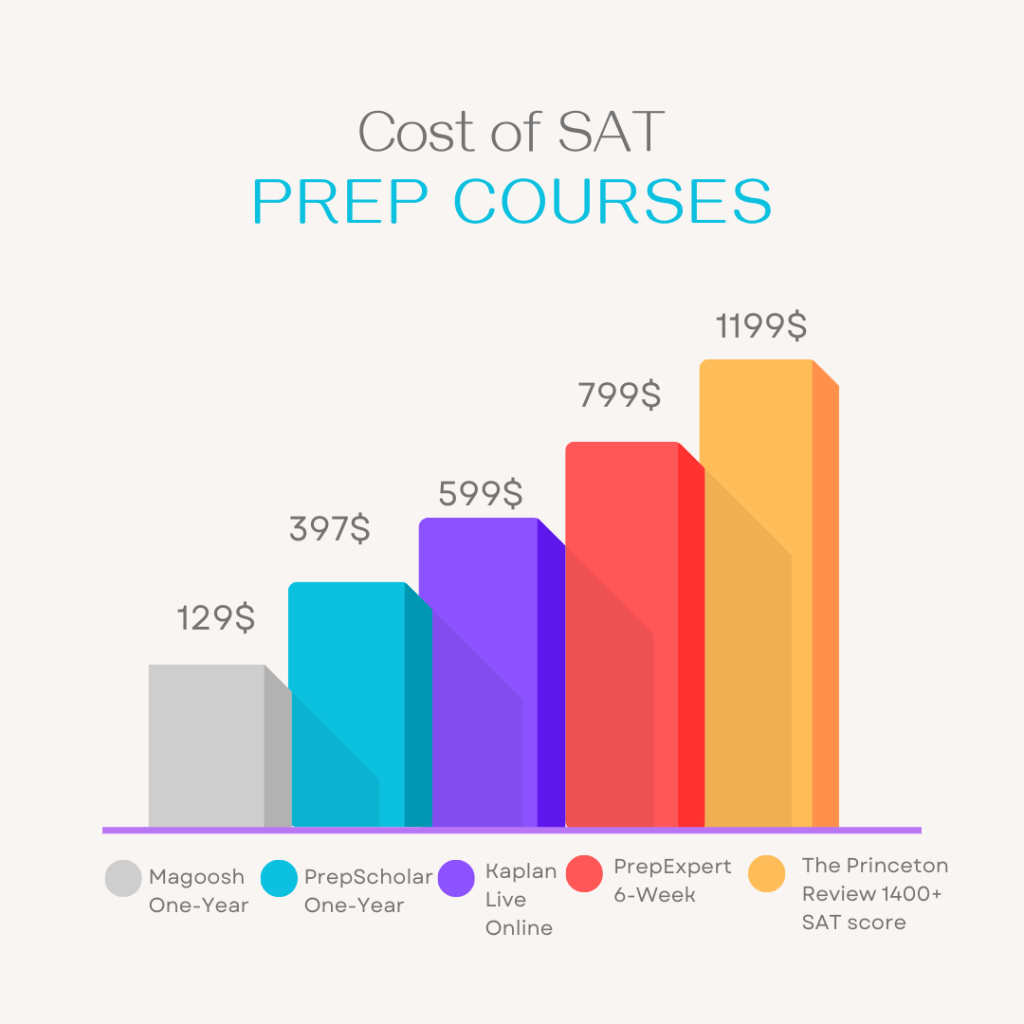
According to prepscholar.com, if you want to be tutored online, it could cost $100 to $1,400. If you want to be tutored in person, that will cost about $800 to $1,800! For the majority of families, that’s no small price. In addition, you have to pay $60 just to take the SAT. According to a representative of the College Board, the company that coordinates and runs the SAT, it costs $60 to take the test. If you want to take the SAT twice, as the College Board recommends for a good score, you will have to pay another $60. The College Board also charges a lot of additional fees, including a $15 fee for you to receive your score over the phone. Additionally, the representative of the College Board informed me that sending SAT scores to colleges costs $12 per college. According to highereddrive.com, in the 2021-22 admissions cycle, each student submitted an average of six applications. That’s $72.
The College Board representative also stated that they are a non-profit-driven organization and yet, in 2019, totalregistration.net reported that the College Board made $1,107,897,207 in revenue! Yes, it does cost money to administer and grade tests in addition to writing them, but the College Board isn’t making $0 in profit. In 2019, their expenses were $1,049,304,734, meaning they profited more than $55 million!
“The coaching industry, which supports the SAT and other admissions tests, casts a shadow over the tests by its very existence. Coaching provides pupils who can buy tutoring with a distinct advantage over other students.”
– Irvin Reid, President of Wayne State University, said to FairTest.org
Additionally, to perform well on the SAT, you need a high-quality education, although this can also be influenced by wealth. Schools in poor communities are often underfunded and typically struggle to provide children with the necessary resources to succeed. On the other hand, wealthy communities have many families with high incomes that can contribute more to fundraisers and similar events. Furthermore, teachers often prefer to work at better-funded schools, which results in understaffed schools in poor communities. Fortunately, things are being done to address this inequality in SAT scores.
For example, there are fee waivers offered by College Board that allow you to take two free SATs and send your SAT scores to colleges for free. To find out if you qualify for a fee waiver, you can speak with your counselor. This change is great, however, this does not address the larger issue: the high cost of SAT prep courses. Another thing being done to eliminate the SAT’s unfairness is that some schools no longer require the SAT. Recently, Columbia University became the first Ivy League school to permanently drop SAT requirements. Their undergraduate admissions department announced the decision on March 1st, 2023. As a result of making the test optional, people with poor grades will no longer be viewed negatively. Those with excellent grades, however, may still benefit from this biased test since they can include their high scores in their applications, giving them an edge in the admissions process. In other words, even if SAT scores are not required, a good SAT score could still highly boost a student’s application. In light of this, it should really be forbidden to accept SAT scores in the first place.
“Schools that use the SAT are throwing away a third of their talent.”
– William Hiss, Dean of Enrollment at Bates College, said when he spoke with FairTest.org
The SAT is a test used by many colleges and universities that can be heavily influenced by your wealth. As a result of this inequality, low-income people receive low-quality education, which could lead to low-paying jobs, creating an endless cycle of poverty. In other words, it keeps the rich, rich, and the poor, poor. Hopefully, colleges will eventually drop this exam from their admissions process completely. Instead, colleges could find other measures of academic achievement to determine an applicant’s academic ability such as the scholar’s grades. This would give lower-income students a better chance at a high-quality education and in turn, help equalize the playing field, which gives everyone an equal chance at success.
 Students of the Sidewalk